


Introduction — ESL, TEFL, TESOL… Which Certification Do You Actually Need?
If you’ve been researching teaching English as a second language certification, you’ve probably run into a frustrating problem:
Some websites say you need ESL certification.
Others say TEFL is better.
Then TESOL appears — and suddenly everything sounds academic and confusing.
Are these certifications different?
Do employers care which one you choose?
And which one actually matters if you want to teach English online or abroad in 2025?
The truth is, most of the confusion comes from terminology, not real requirements.
Many employers use ESL, TEFL, and TESOL interchangeably, even though they technically mean different things. Other sites exaggerate those differences to sell expensive courses — or make the process sound more complicated than it really is.
This guide clears everything up.
In this article, you’ll learn:
- what an ESL certification really is
- how ESL, TEFL, and TESOL actually differ
- which certification employers truly care about
- when certification is required — and when it isn’t
- which option makes the most sense for beginners in 2025
By the end, you’ll know exactly which certification matches your goals — without overpaying or choosing the wrong path. Let’s start by defining what an ESL certification actually means.
What Is a Teaching English as a Second Language (ESL) Certification?
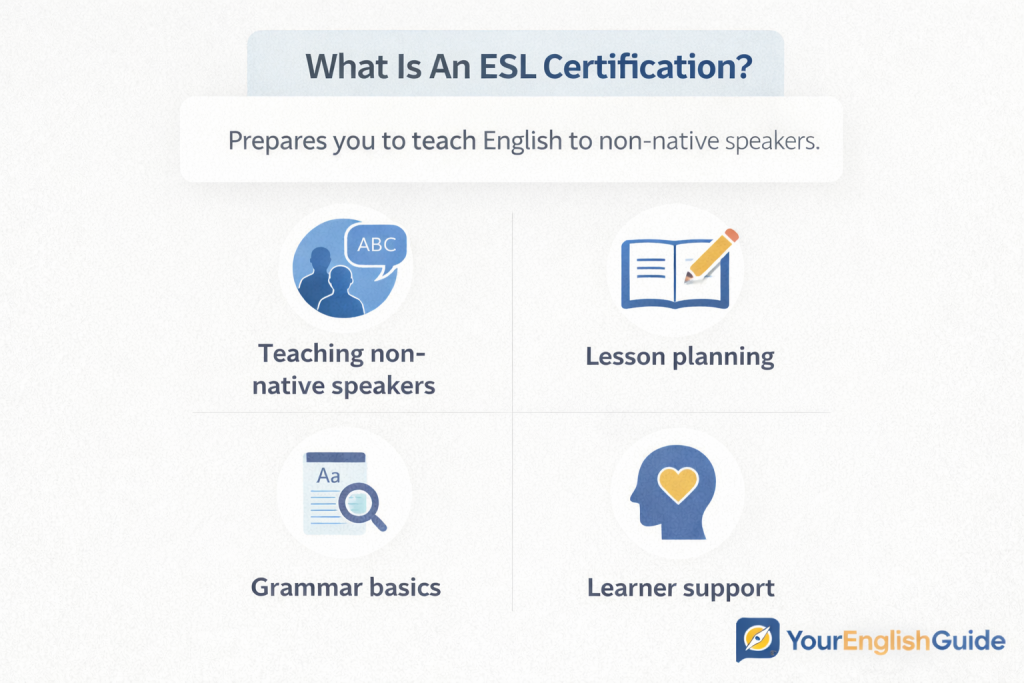
A Teaching English as a Second Language (ESL) certification is a qualification that shows you’ve learned the basics of teaching English to non-native speakers.
At its core, an ESL certification is designed to prove that you understand:
- how people learn English as an additional language
- how to explain grammar and vocabulary clearly
- how to plan and deliver lessons
- how to support learners from different language backgrounds
It does not mean you are a licensed teacher, and it does not require prior teaching experience.
What ESL Certification Actually Means
Technically, ESL refers to teaching English to learners who live in an English-speaking environment (for example, immigrants or international students living in the US, UK, or other English-speaking countries).
In practice, however, the term ESL certification is often used more broadly to describe general English teaching qualifications.
That’s why you’ll see:
- ESL used on university programs
- ESL used in school systems
- ESL used interchangeably with TEFL or TESOL on job listings
This overlap causes a lot of confusion — especially for beginners.
Is ESL Certification the Same as TEFL or TESOL?
Short answer:
Not exactly — but for most jobs, the difference is not as important as people think.
Here’s the simple version:
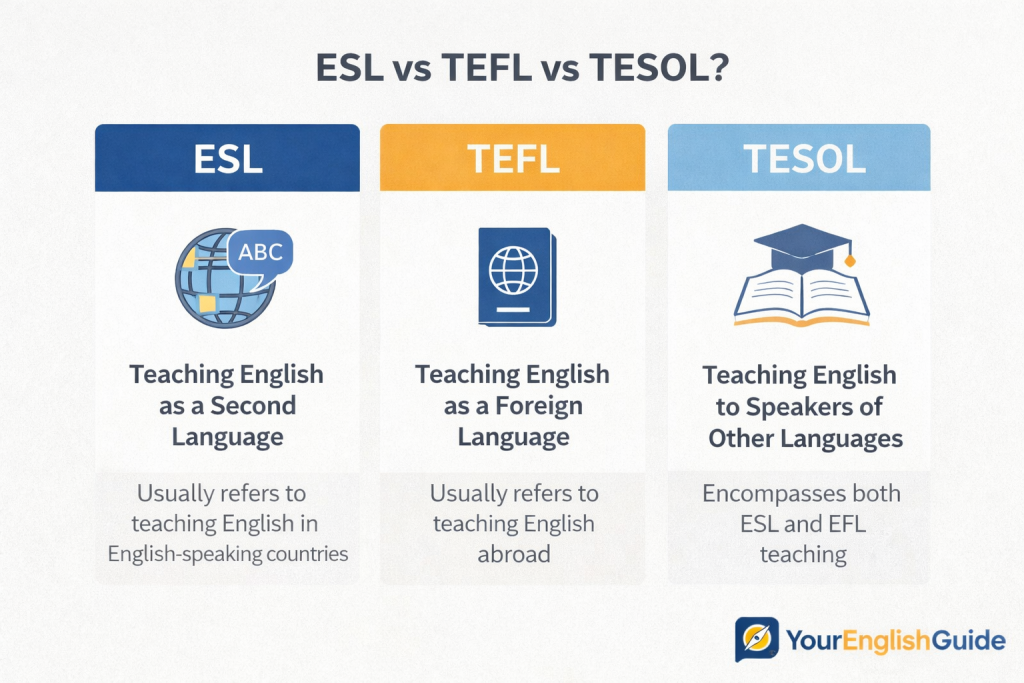
- ESL describes a teaching context
- TEFL describes teaching English as a foreign language
- TESOL is an umbrella term that can include both
Most employers care less about the label and more about:
- whether your course covered core teaching skills
- whether it was at least 120 hours
- whether it was completed successfully
We’ll break down the real differences next — without jargon or sales language.
Who ESL Certification Is For
An ESL certification can be useful if you:
- want to teach English online
- plan to teach English abroad
- want a basic, widely recognized qualification
- have no prior teaching experience
- want flexibility rather than an academic teaching license
For most beginners, ESL certification is about access, not prestige.
Key Takeaway
An ESL certification is a foundational English teaching qualification.
It shows you understand how to teach English to non-native speakers — but the name alone doesn’t determine your job options. What matters more is how employers interpret it, which leads us to the next section.
ESL vs TEFL vs TESOL — What’s the Real Difference?
This is where most people get stuck — and where most articles make things unnecessarily complicated.
The good news is that the differences are simpler than they sound, especially if your goal is to teach English online or abroad.
Let’s break each term down clearly.
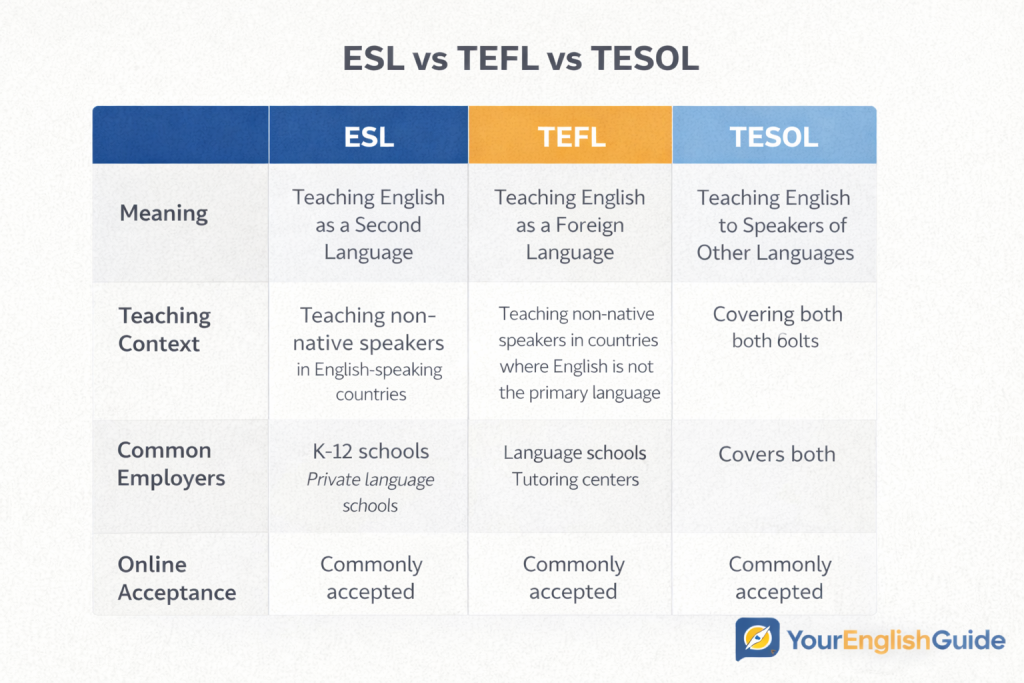
ESL (Teaching English as a Second Language)
ESL technically refers to teaching English to learners who live in an English-speaking country.
Typical ESL contexts include:
- immigrants learning English in the US, UK, Canada, or Australia
- international students studying in English-speaking countries
- adult education or community language programs
ESL is often used in:
- schools
- colleges
- government or community programs
Because of this, ESL sometimes sounds more academic or institutional, even when the actual teaching skills are the same.
TEFL (Teaching English as a Foreign Language)
TEFL refers to teaching English in a non-English-speaking country or to students living abroad.
This is the most common term used for:
- teaching English online
- teaching English abroad
- private language schools
- online platforms
Most online teaching companies and international schools use the term TEFL, even if the job itself looks very similar to ESL teaching.
This is why TEFL certificates are often the most widely recognized for online and overseas teaching.
TESOL (Teaching English to Speakers of Other Languages)
TESOL is a broader umbrella term that can include both ESL and TEFL.
TESOL is commonly used:
- in university programs
- in academic qualifications
- in more formal teacher training
In practice, TESOL certificates often cover the same core content as ESL or TEFL certificates, but the name sounds more academic.
Some employers prefer TESOL wording, but many treat it as interchangeable with TEFL.
Which Certification Term Do Employers Actually Care About?
Here’s the most important truth:
👉 Most employers care far more about what your course included than what it was called.
What employers usually look for:
- a minimum of 120 hours
- coverage of grammar, lesson planning, and teaching methods
- completion from a recognized provider
- proof you finished the course
In many job listings, you’ll see phrases like:
- “TEFL / TESOL / ESL certification required”
- “TEFL or equivalent”
This means the content matters more than the label.
Key Takeaway
- ESL, TEFL, and TESOL are closely related, not competing paths
- The terms are often used interchangeably by employers
- For most people, TEFL or TESOL-style certification works perfectly, even if the job says “ESL”
- Choosing the right course quality matters more than choosing the right name
Now that the terminology is clear, the next question is whether certification is actually required at all.
Do You Need an ESL Certification to Teach English?
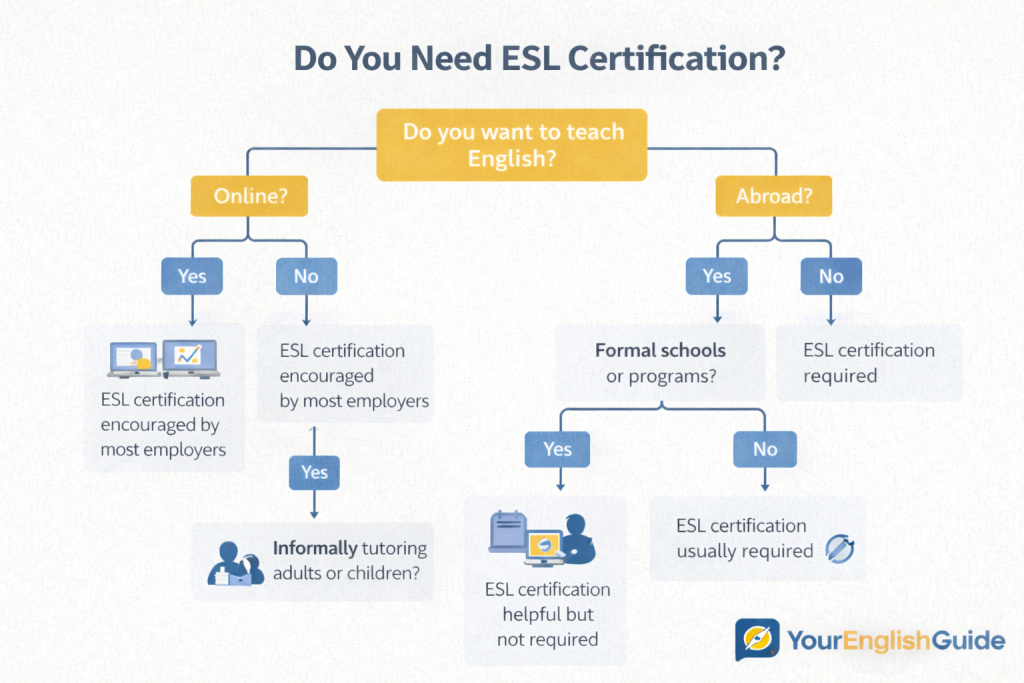
The short answer is: sometimes yes, sometimes no — and it depends on where and how you want to teach.
This is where many people either overpay for certification or skip it when they shouldn’t.
When ESL Certification Is Required
You are most likely to need an ESL (or equivalent) certification if you plan to teach:
- in formal school systems
- in colleges or universities
- in government-funded language programs
- in certain countries with strict regulations
In these cases, certification is often a non-negotiable requirement, even if you already speak English fluently.
Some employers need certification for:
- legal compliance
- accreditation
- visa or work permit rules
Here, the certification is proof of basic teaching competence, not teaching mastery.
When ESL Certification Is Optional
In many situations, ESL certification is recommended but not required.
This is common with:
- online English teaching platforms
- conversation-based tutoring
- informal or private language schools
- short-term or entry-level teaching roles
Some platforms will hire you without certification but:
- pay less
- limit opportunities
- encourage certification later
For beginners, certification often improves hiring chances and confidence, even when it’s optional.
When ESL Certification Is Strongly Recommended
Even if it’s not required, ESL certification is strongly recommended if you:
- have no teaching experience
- are changing careers
- want to teach online
- want access to more platforms
- want to avoid beginner mistakes
For many people, certification replaces experience in the eyes of employers.
Key Takeaway
You don’t always need an ESL certification to teach English — but having one gives you more options, fewer rejections, and a smoother start.
The real question isn’t “Do I need it?”
It’s “Which certification actually makes sense for my goals?”
What Does an ESL Certification Course Include?
Not all ESL certification courses are the same — but most legitimate ones cover a core set of teaching skills that employers expect.
Understanding what’s included helps you avoid overpaying or choosing a course that’s too weak.
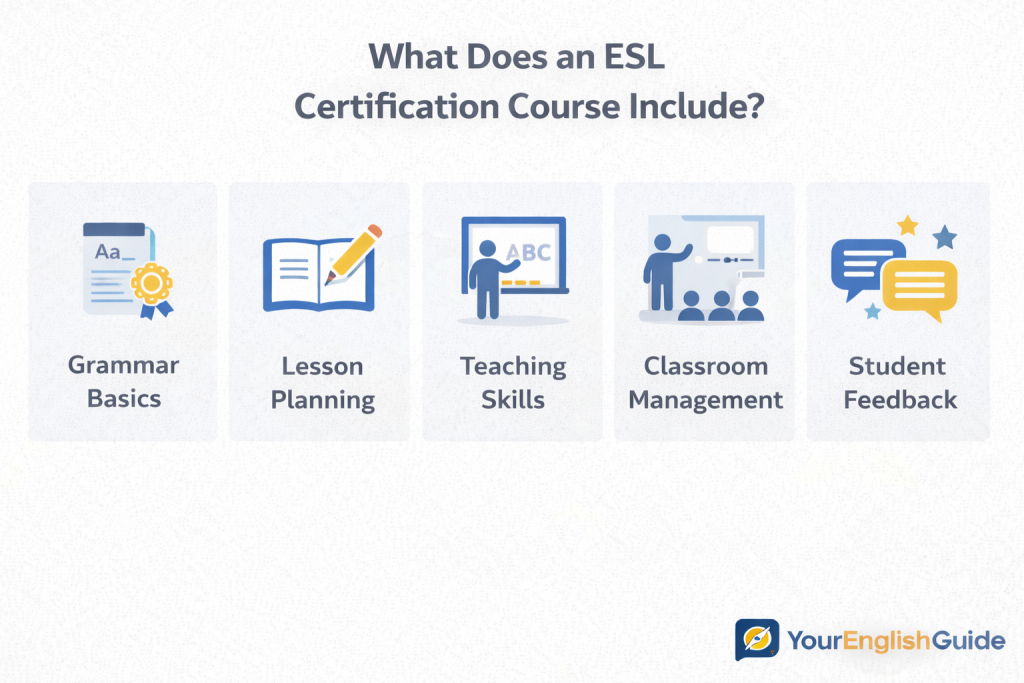
Core Topics Covered in ESL Certification
A standard ESL certification course usually includes:
- How English is taught to non-native speakers
- Basic grammar explanations (tense, sentence structure, common errors)
- Lesson planning fundamentals
- Teaching speaking, listening, reading, and writing
- Classroom or online classroom management
- Error correction and student feedback
You’re not expected to become a grammar expert — the goal is to teach clearly and confidently, not academically.
Practicum vs Online-Only Courses
Some ESL certifications include a practicum, which means supervised teaching practice.
Here’s how employers usually see it:
- With practicum:
- Helpful for in-person school jobs
- Sometimes required for academic roles
- More time-consuming and expensive
- Online-only (no practicum):
- Widely accepted for online teaching
- Accepted by many language schools abroad
- Faster and more affordable
For online teaching, a practicum is usually not required.
How Long Does ESL Certification Take?
Most ESL certification courses take:
- 4–12 weeks for self-paced online courses
- Longer for part-time or university-based programs
Many online courses allow you to:
- study at your own pace
- finish faster if you have time
- pause and resume as needed
There is no advantage to rushing — employers only care that you completed the course properly.
Key Takeaway
A legitimate ESL certification teaches practical teaching skills, not just theory.
For most beginners:
- online-only courses are sufficient
- practicum is optional
- clarity and completeness matter more than prestige
Next, let’s compare online vs in-person ESL certification so you can choose what fits your situation.
Online vs In-Person ESL Certification
One of the biggest decisions you’ll face is whether to choose an online ESL certification or an in-person program.
In 2025, this choice matters far less than it used to — but there are still situations where one makes more sense than the other.
Online ESL Certification
Online ESL certification is now the most common option, especially for people who want flexibility.
Pros:
- widely accepted by online teaching platforms
- affordable compared to in-person programs
- flexible, self-paced study
- accessible from anywhere in the world
- ideal for beginners and career changers
Cons:
- little or no supervised teaching practice
- less personal feedback
- not always accepted by universities or public schools
For most people who want to teach English online or abroad, online certification is more than sufficient.
In-Person ESL Certification
In-person ESL certification is usually more formal and structured.
Pros:
- includes supervised teaching practice
- preferred for academic or school-based jobs
- strong foundation for long-term teaching careers
Cons:
- higher cost
- fixed schedules
- location-dependent
- unnecessary for many online teaching jobs
In-person certification makes sense if you:
- plan to work in schools or universities
- need a practicum for visa or legal reasons
- want an academic teaching pathway
What Employers Actually Accept in 2025
Most employers today care about:
- whether your certification is at least 120 hours
- whether it covers core teaching skills
- whether it was completed successfully
For online teaching platforms, online ESL certification is usually accepted without issue.
For formal institutions, in-person or practicum-based programs may still be preferred.
Key Takeaway
If your goal is to:
- teach English online
- teach abroad in private language schools
- get started quickly and affordably
👉 Online ESL certification is usually the best choice.
In-person certification is best reserved for academic or school-based teaching careers.
How Much Does ESL Certification Cost?
The cost of ESL certification varies widely — and this is where many beginners either overpay or get pulled into unnecessary upgrades.
Let’s break down what you should realistically expect to spend.
Low-Cost Online ESL Certifications
Most legitimate online ESL certification courses fall into a reasonable, beginner-friendly price range.
Typical features include:
- self-paced online study
- 120 hours of coursework
- certificate of completion
- basic teaching methodology
These courses are:
- widely accepted for online teaching
- suitable for beginners
- the most cost-effective option
For most people, this level of certification is all you need to get started.
Expensive ESL Programs (And When They’re Worth It)
Some ESL certification programs are significantly more expensive, especially those offered by:
- universities
- colleges
- teacher training institutes
These programs may include:
- supervised teaching practice
- academic credits
- longer completion times
They can be worth it if you:
- plan to teach in formal school systems
- want an academic teaching career
- need certification for visa or licensing reasons
For teaching English online, these programs are usually more than necessary.
What You Should NOT Pay For
Be cautious of courses that charge extra for:
- “guaranteed job placement”
- premium memberships
- lifetime access packages
- expensive add-ons that don’t improve employability
No certification can guarantee a job.
Employers care about:
- whether you completed a legitimate course
- whether you can teach clearly
- how you perform in interviews and demo lessons
Key Takeaway
You don’t need the most expensive ESL certification to succeed.
For most beginners, a simple, affordable online certification provides everything employers expect — without unnecessary cost.
Is ESL Certification Worth It in 2025?
For most people who want to teach English, the answer is yes — but only when your goals actually require it.
ESL certification isn’t about prestige.
It’s about access, confidence, and credibility.
When ESL Certification Is Worth It
ESL certification is worth it if you:
- want to teach English online
- have no teaching experience
- are changing careers
- want to qualify for more platforms
- want to avoid repeated rejection
- want basic teaching structure and confidence
For beginners, certification often replaces experience and helps employers trust that you understand how to teach, not just how to speak English.
When ESL Certification May Not Be Necessary
You may not need ESL certification if you:
- already have teaching experience
- are tutoring informally
- are helping friends or language partners
- are teaching conversation casually
In these cases, certification may add little value unless required by an employer.
ESL Certification as a Long-Term Investment
Even when not required, ESL certification can:
- open doors later
- make career progression easier
- increase credibility with employers
- reduce stress during interviews
Many teachers who skipped certification early end up getting it later anyway.
Key Takeaway
ESL certification is worth it in 2025 if you want more options and fewer barriers.
The goal isn’t to collect certificates — it’s to choose the right level of qualification for your goals.
ESL Certification and Teaching English Online
One of the most common questions people ask is whether an ESL certification actually helps with teaching English online — or if it’s just a formality.
In most cases, it does help, but not always in the way people expect.
Can You Teach English Online With an ESL Certification?
Yes. An ESL certification is widely accepted for teaching English online — especially when it meets these criteria:
- at least 120 hours
- covers teaching methodology and lesson planning
- focuses on teaching non-native speakers
- completed through a recognized provider
Many online platforms list their requirement as:
“TEFL / TESOL / ESL certification or equivalent”
This means an ESL certification usually qualifies without issue.
ESL Certification vs TEFL for Online Teaching
In practice, ESL and TEFL certifications are treated very similarly by online teaching platforms.
Here’s how it usually works:
- Platforms use TEFL language because it’s internationally familiar
- ESL certification is often accepted as an equivalent qualification
- Employers rarely reject a candidate solely because the certificate says “ESL” instead of “TEFL”
What matters more is:
- course length
- course content
- your interview and demo lesson performance
For online teaching, the certificate label is secondary.
H3: When ESL Certification Gives You an Advantage Online
An ESL certification can give you an edge if you:
- have no teaching experience
- are applying to multiple platforms
- want to teach beginners or adults
- want to feel more confident during demos
- want to avoid basic teaching mistakes
Certification shows employers that you’ve taken teaching seriously — even if you’re new.
Key Takeaway
If your goal is to teach English online, an ESL certification is absolutely usable and often helpful.
The most important factors remain:
- your communication skills
- your preparation
- your ability to engage students
Certification supports those skills — it doesn’t replace them.
FAQs — Teaching English as a Second Language Certification
What is a teaching English as a second language (ESL) certification?
An ESL certification is a qualification that shows you have learned the basics of teaching English to non-native speakers. It covers lesson planning, grammar fundamentals, teaching methods, and learner support, and is commonly used for both online and in-person English teaching.
Is ESL certification the same as TEFL?
Not exactly, but they are often treated as equivalent. ESL refers to teaching English in an English-speaking environment, while TEFL refers to teaching English in non-English-speaking countries. In practice, many employers accept ESL, TEFL, or TESOL certifications interchangeably, as long as the course meets standard requirements.
Do I need an ESL certification to teach English online?
Not always. Some online platforms hire teachers without certification, especially for conversation-based roles. However, having an ESL (or equivalent) certification improves your chances of getting hired and gives you access to more opportunities.
How long does ESL certification take?
Most online ESL certification courses take 4 to 12 weeks, depending on whether they are self-paced or structured. Some learners finish faster, while others take more time to study comfortably.
Is online ESL certification valid?
Yes. Online ESL certification is widely accepted in 2025, especially for teaching English online and for many private language schools abroad. Employers care more about course quality and length than whether it was completed online or in person.
Is ESL certification worth it for beginners?
Yes, for most beginners ESL certification is worth it. It helps replace experience, improves confidence, and makes it easier to pass interviews and demo lessons. It is especially helpful for people teaching English for the first time.
Final Verdict — Which English Teaching Certification Should You Choose?
Choosing a teaching English as a second language certification doesn’t have to be complicated — despite how confusing the terminology can seem.
For most people, the decision is less about the name of the certificate and more about how and where you want to teach.
Best Choice for Teaching English Online
If your goal is to teach English online, the safest and most practical option is:
- a 120-hour TEFL, TESOL, or ESL certification
- completed online
- focused on teaching non-native speakers
Most online teaching platforms treat ESL, TEFL, and TESOL as equivalent, as long as the course content meets standard expectations.
In other words:
👉 The label matters far less than the quality and length of the course.
Best Choice for Teaching English Abroad
If you plan to teach English abroad:
- TEFL-style certifications are most commonly requested
- ESL or TESOL certifications are often accepted as equivalents
- Some countries or schools may require:
- a practicum
- in-person training
- additional qualifications
Always check country- or school-specific requirements before enrolling in a course.
Best Choice for Beginners
For beginners with:
- no teaching experience
- no education background
- career-change goals
A basic online ESL/TEFL/TESOL certification is usually the best starting point.
It provides:
- structure
- confidence
- credibility
- access to more opportunities
You don’t need the most expensive program to get started.
Final Advice
Don’t choose a certification based on:
- marketing promises
- job guarantees
- expensive add-ons
Instead, choose one that:
- meets employer expectations
- fits your teaching goals
- fits your budget
- prepares you to teach confidently
Certification is a tool — not a shortcut.
CTA — Choose the Certification That Matches Your Goals
If you’re serious about teaching English, the next step is simple:
👉 Decide where you want to teach (online, abroad, or both).
👉 Choose a legitimate, recognized ESL/TEFL/TESOL certification that fits that goal.
👉 Focus on learning how to teach clearly and confidently.
That approach will take you much further than chasing labels.