


Introduction — What Are the Best TEFL Courses in 2026?
Searching for the best TEFL courses can quickly become overwhelming.
Every provider claims to be “internationally recognized.”
Every course promises “job support.”
And prices range from surprisingly cheap to shockingly expensive — often without a clear reason why.
The reality is this:
👉 There is no single “best” TEFL course for everyone.
What is best depends on:
- where you want to teach (online or abroad)
- whether you’re a complete beginner
- how much support you need
- how much you’re willing (and able) to spend
Some TEFL courses are excellent for online teaching but unnecessary for classroom work.
Others are respected by schools abroad but overkill for beginners.
And a few are simply overpriced for what they offer.
This guide cuts through the noise.
In this article, you’ll find:
- how we define the best TEFL courses
- which TEFL courses stand out for different goals
- what actually matters to employers in 2026
- how to avoid paying for features you don’t need
- which options make the most sense for beginners
Everything here is based on employer expectations, real-world teaching requirements, and practical value — not marketing claims.
Let’s start with a quick answer before diving into the details.
Quick Answer — What Are the Best TEFL Courses in 2026?
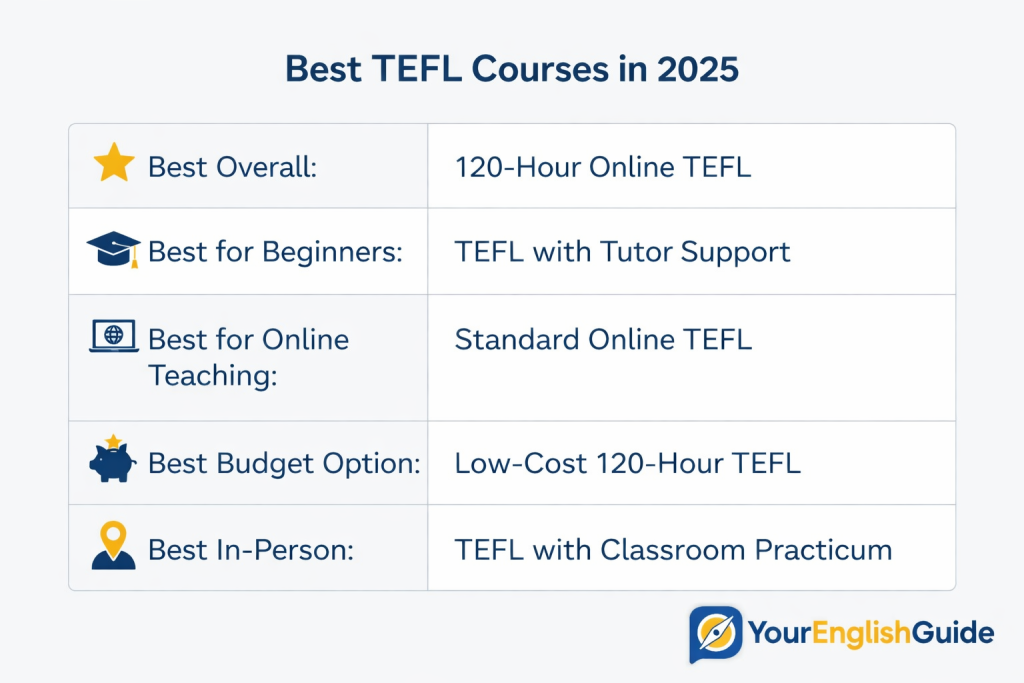
The best TEFL courses in 2026 depend on how and where you want to teach. There is no single course that’s best for everyone — but there are clear best options for specific goals.
Here’s a quick overview before we go deeper:
- Best overall TEFL course:
A 120-hour, internationally recognized online TEFL with strong course content and employer acceptance. - Best TEFL course for beginners:
A structured online TEFL course with clear modules, practical examples, and beginner support. - Best TEFL course for teaching English online:
An online TEFL that meets platform requirements (usually 120 hours) and focuses on teaching adults or conversation. - Best budget TEFL course:
A low-cost online TEFL that still meets minimum employer standards — without unnecessary add-ons. - Best in-person TEFL course:
An in-person or practicum-based TEFL for those planning to teach in schools abroad that require classroom experience.
Important:
“Best” does not mean “most expensive” or “most advertised.” It means best fit for your goals and employer requirements.
In the sections below, we’ll explain how we evaluated these courses, then break down the best options category by category — so you can choose confidently.
How We Chose the Best TEFL Courses
With so many TEFL courses available, it’s easy to assume that the most popular or expensive options must be the best. In reality, price and marketing don’t reliably reflect quality.
To create this guide, we focused on what actually matters to employers, teaching platforms, and beginners — not what looks good in ads.
Our Evaluation Criteria
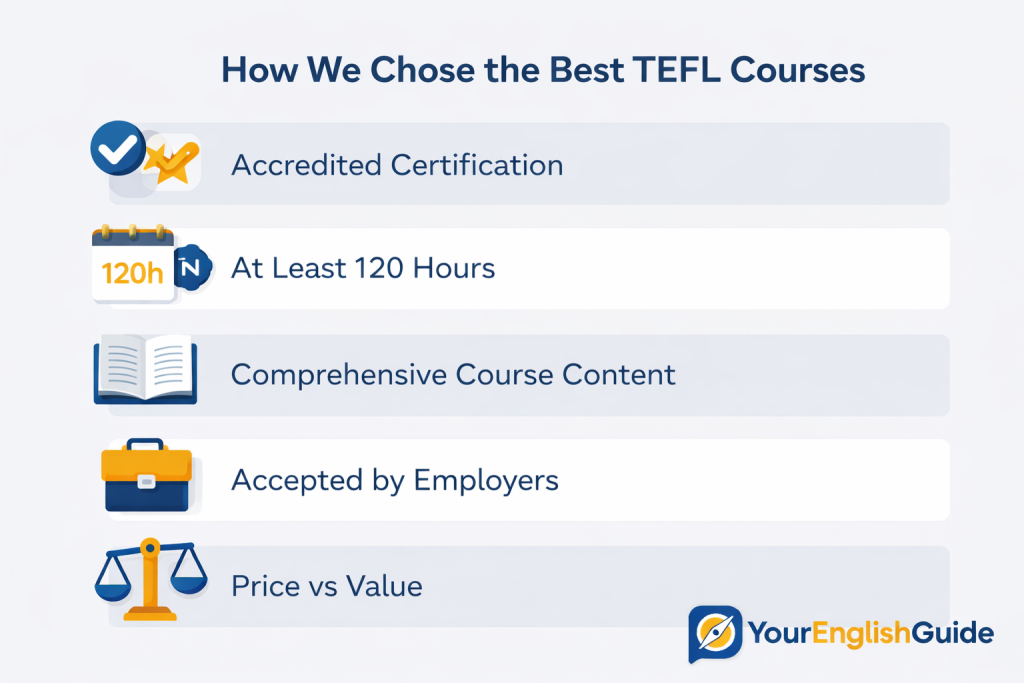
Every TEFL course featured in this guide was evaluated using the same core criteria:
- Accreditation or recognition
Whether the course is accepted by online teaching platforms and language schools. - Course length
A minimum of 120 hours, which is the industry standard for most teaching jobs. - Course content quality
Coverage of lesson planning, grammar basics, classroom management, and teaching methods. - Online vs in-person format
Whether the format matches real teaching requirements in 2026. - Employer acceptance
How TEFL certificates are viewed by online platforms and schools abroad. - Price vs value
Whether the course offers practical value without unnecessary upsells.
Courses that failed to meet basic employer expectations were excluded — regardless of how popular or heavily advertised they were.
What “Best” Actually Means for TEFL Courses
In this guide, “best” does not mean one single winner.
Instead, it means:
- best TEFL course for beginners
- best TEFL course for teaching English online
- best TEFL course on a budget
- best TEFL course for in-person teaching abroad
Different goals require different features. A course that’s perfect for teaching online may be unnecessary for classroom teaching — and vice versa.
That’s why the recommendations below are goal-based, not ranked by hype.
Key Takeaway
The best TEFL course is the one that:
- meets employer requirements
- fits your teaching goals
- fits your budget
- prepares you to teach confidently
With that framework in place, let’s look at the best TEFL course options by category.
Best TEFL Courses Overall (2026 Picks)
Rather than naming a single “best” TEFL course, this section highlights the best types of TEFL courses for different goals.
This approach reflects how employers actually hire — and helps you choose a course that fits your situation, not just a headline claim.
Best Overall TEFL Course
The best overall TEFL course in 2026 typically has these features:
- at least 120 hours of training
- clear, structured modules
- practical teaching methodology
- strong employer acceptance
- no unnecessary upsells
This type of course works well for:
- beginners
- online teaching
- teaching abroad in private language schools
For most people, this is the safest and most flexible choice.
Best TEFL Course for Beginners
If you’re completely new to teaching, the best beginner TEFL course is one that:
- explains grammar simply
- includes practical examples and scenarios
- avoids academic overload
- is self-paced and easy to follow
Beginner-friendly courses focus on confidence and clarity, not theory-heavy instruction.
They’re ideal if you:
- have no teaching background
- want to teach English online
- want a gentle learning curve
Best TEFL Course for Teaching English Online
For teaching English online, the best TEFL courses are usually:
- fully online
- accepted by major teaching platforms
- focused on teaching adults or conversation
- aligned with platform requirements
In most cases, online teaching platforms care about:
- course length
- completion proof
- teaching readiness
They rarely require in-person training or practicum.
Best Budget TEFL Course
A good budget TEFL course should still:
- meet the 120-hour standard
- be clearly structured
- provide a legitimate certificate
Low cost does not automatically mean low quality — but extremely cheap courses with no clear curriculum should be avoided.
Budget courses work best if you:
- want to start quickly
- plan to teach online
- don’t need extra support
Best In-Person TEFL Course
In-person TEFL courses are best for people who:
- plan to teach in formal schools abroad
- need classroom teaching practice
- want face-to-face training
These courses are usually:
- more expensive
- time-intensive
- location-specific
For online teaching, in-person courses are rarely necessary.
Key Takeaway
The “best” TEFL course depends on your goal — not the brand name.
Once you understand which type of course you need, choosing the right provider becomes much easier.
In-Depth Reviews of the Best TEFL Courses
Instead of overwhelming you with dozens of options, this section breaks down the most common types of TEFL courses you’ll see — and what they’re actually good for.
The goal here is to help you recognize a good TEFL course when you see one, even before choosing a specific provider.
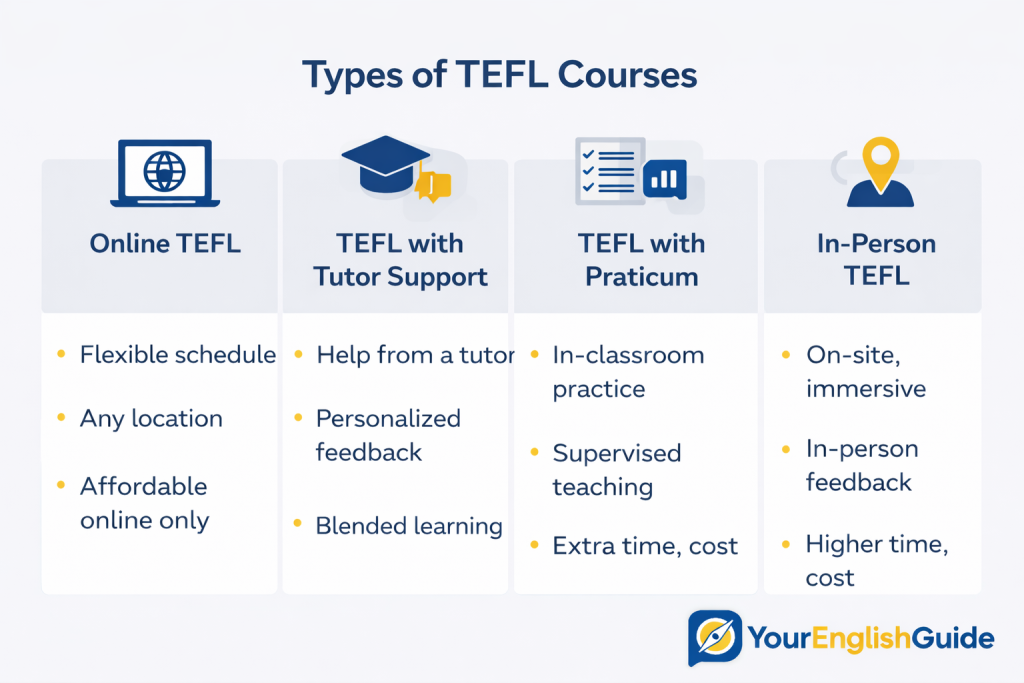
Course Type #1 — Standard 120-Hour Online TEFL
Best for:
Beginners, online teaching, flexible schedules
Overview:
This is the most common and widely accepted TEFL format. A standard 120-hour online TEFL course focuses on practical teaching skills and meets the minimum requirement for most online platforms and private language schools.
What it usually includes:
- self-paced online modules
- lesson planning fundamentals
- grammar basics explained simply
- teaching speaking, listening, reading, and writing
- final assessment or quizzes
Pros:
- affordable
- flexible
- widely accepted
- ideal for first-time teachers
Cons:
- limited personal feedback
- no in-person teaching practice
Verdict:
For most people, this is the best starting point.
Course Type #2 — TEFL With Tutor Support or Feedback
Best for:
Beginners who want guidance and reassurance
Overview:
Some TEFL courses include tutor feedback, graded assignments, or limited instructor support. These courses still run online but offer more structure.
What it usually includes:
- assignment feedback
- optional tutor support
- clearer progression checkpoints
Pros:
- more confidence-building
- better preparation for interviews
- helpful for nervous beginners
Cons:
- higher cost than basic online TEFL
- still no in-person practicum
Verdict:
A good option if you want extra support without committing to in-person training.
Course Type #3 — TEFL With Practicum or Classroom Practice
Best for:
Teaching abroad in schools with stricter requirements
Overview:
These courses include supervised teaching practice, often in a classroom setting. They are more time-intensive and expensive.
What it usually includes:
- observed teaching hours
- lesson delivery practice
- instructor feedback
Pros:
- stronger classroom preparation
- preferred by some schools abroad
Cons:
- higher cost
- limited flexibility
- unnecessary for most online teaching jobs
Verdict:
Best if you know you’ll need classroom experience.
Course Type #4 — University or Academic TEFL Programs
Best for:
Long-term academic teaching careers
Overview:
These programs are often part of a university qualification and may lead to formal teaching credentials.
Pros:
- academic recognition
- suitable for formal education systems
Cons:
- expensive
- time-consuming
- unnecessary for most online or entry-level teaching
Verdict:
Only worth it if you plan to pursue formal teaching roles.
Key Takeaway
You don’t need the most advanced TEFL course to start teaching.
For most people:
- a standard 120-hour online TEFL is enough
- extra features should match real requirements, not marketing claims
Online vs In-Person TEFL Courses — Which Is Better?
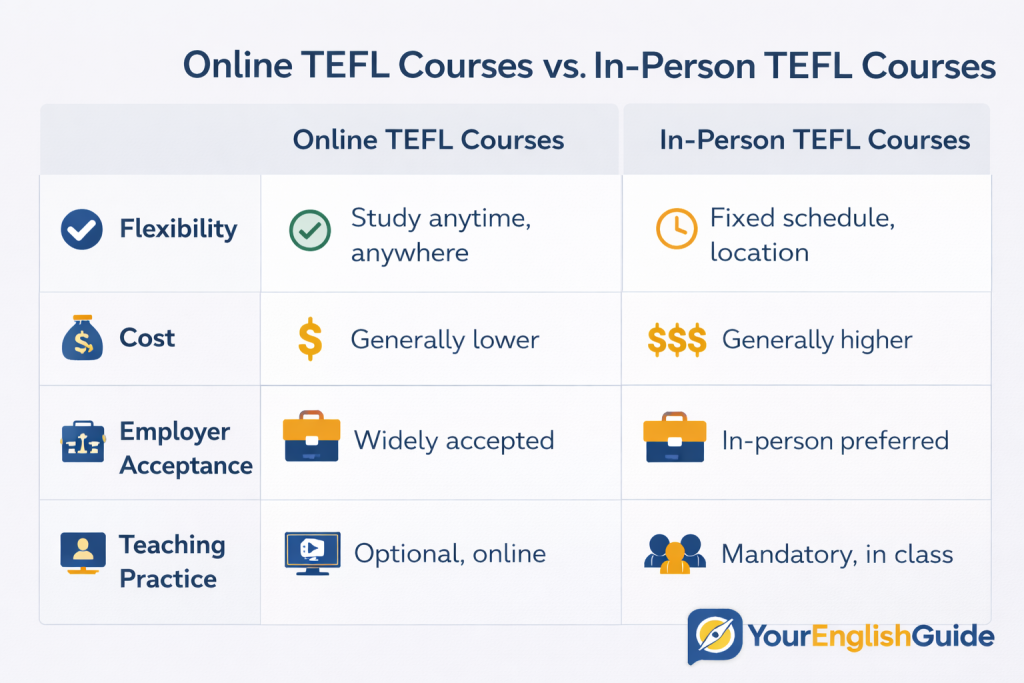
One of the most common questions people ask when choosing the best TEFL courses is whether an online or in-person course is better.
In 2026, the answer depends almost entirely on how and where you plan to teach.
Online TEFL Courses
Online TEFL courses are the most popular option — and for good reason.
Best for:
- teaching English online
- beginners and career changers
- flexible schedules
- budget-conscious learners
Why employers accept them:
- most platforms require only a 120-hour TEFL
- online teaching doesn’t require classroom practice
- content matters more than delivery format
Pros:
- flexible and self-paced
- affordable
- widely accepted
- accessible from anywhere
Cons:
- no in-person teaching practice
- limited real-time feedback
For most people looking to teach English online or work in private language schools abroad, online TEFL courses are more than sufficient.
In-Person TEFL Courses
In-person TEFL courses are more structured and intensive.
Best for:
- teaching in formal schools abroad
- countries with strict visa requirements
- people who want classroom teaching practice
Pros:
- supervised teaching experience
- face-to-face instructor feedback
- sometimes preferred by schools
Cons:
- significantly more expensive
- fixed schedules
- location-dependent
- unnecessary for online teaching
In-person TEFL courses make sense only if you know you need practicum or classroom hours.
What Employers Actually Prefer in 2026
Most employers care about:
- course length (120+ hours)
- completion proof
- teaching readiness
They care far less about:
- whether the course was online or in-person
- the provider’s marketing claims
For online teaching platforms, online TEFL is usually the default and accepted option.
Key Takeaway
If your goal is to:
- teach English online
- get started quickly
- avoid unnecessary costs
👉 An online TEFL course is usually the best choice.
In-person TEFL courses are best reserved for specific teaching situations, not general use.
How Much Do TEFL Courses Cost?
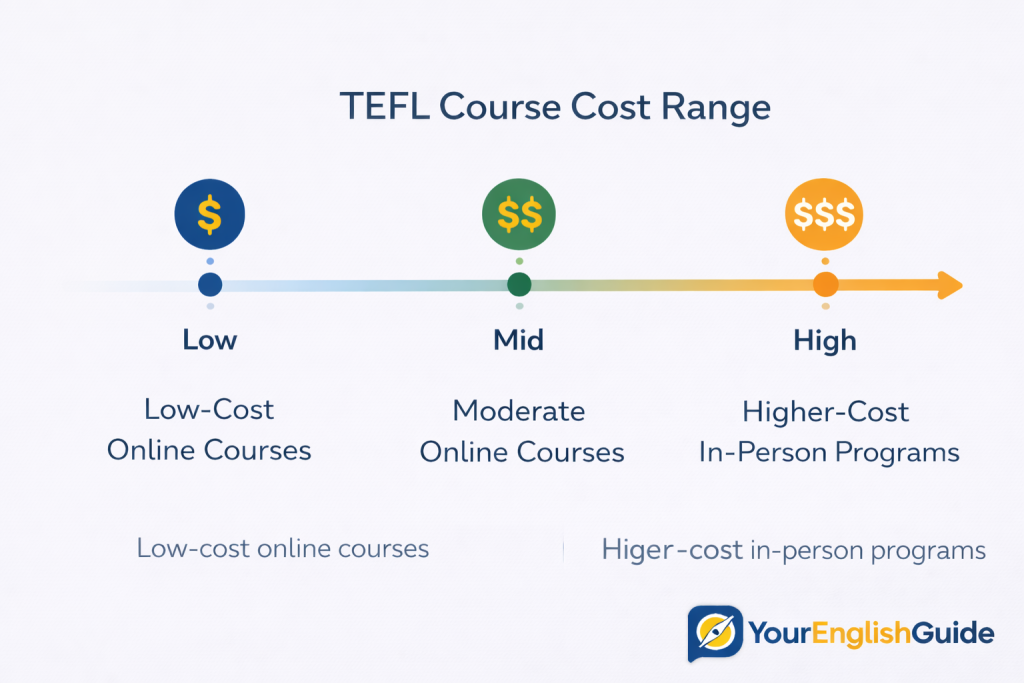
TEFL course prices vary widely — and higher cost does not automatically mean higher quality.
Understanding what you’re actually paying for helps you avoid overpriced programs and unnecessary upgrades.
Low-Cost TEFL Courses
Low-cost TEFL courses are usually online-only and meet the basic requirements for most teaching jobs.
What they typically offer:
- 120 hours of coursework
- self-paced learning
- certificate of completion
- core teaching methodology
Best for:
- teaching English online
- beginners who want to start quickly
- people on a tight budget
As long as the course meets employer standards, low-cost does not mean low value.
Mid-Range TEFL Courses
Mid-range TEFL courses often include additional support.
What you may get:
- graded assignments
- tutor feedback
- clearer course structure
- interview or demo lesson preparation
These courses are ideal if you:
- want guidance as a beginner
- feel unsure about teaching skills
- value feedback over speed
Expensive TEFL Courses (When They’re Worth It)
High-cost TEFL courses are usually:
- in-person
- practicum-based
- university-affiliated
They may be worth it if you:
- plan to teach in formal schools abroad
- need classroom teaching practice
- require certification for visa purposes
For teaching English online, these courses are often more than necessary.
What You Should NOT Pay Extra For
Be cautious of courses that charge extra for:
- “guaranteed job placement”
- premium memberships
- lifetime access add-ons
- branded certificates
No TEFL course can guarantee a job.
Employers care about:
- course length
- teaching readiness
- interview performance
Key Takeaway
You don’t need the most expensive TEFL course to succeed.
For most people, a basic or mid-range online TEFL offers the best balance of cost, acceptance, and practicality.
Are TEFL Courses Worth It in 2026?
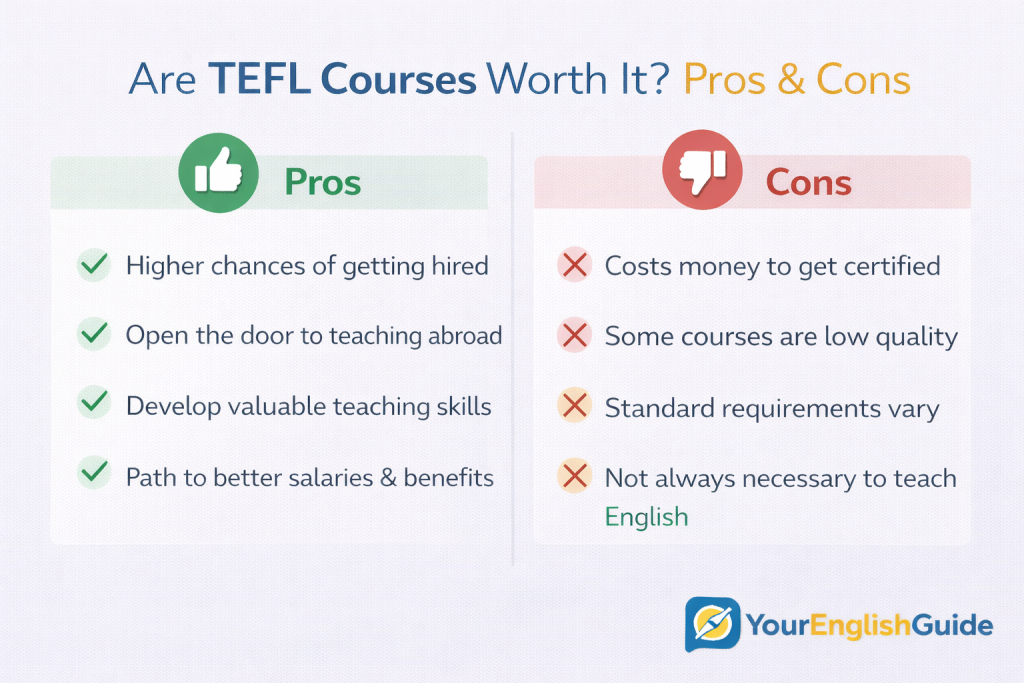
For most people who want to teach English, yes — TEFL courses are still worth it in 2026, but only when chosen for the right reasons.
A TEFL course is not about prestige or guarantees.
It’s about meeting employer expectations and being prepared to teach.
When TEFL Courses Are Worth It
A TEFL course is worth it if you:
- want to teach English online
- plan to teach abroad in private language schools
- have no teaching experience
- want to qualify for more platforms
- want confidence during interviews and demo lessons
For beginners, a TEFL certificate often acts as a replacement for experience in the eyes of employers.
When TEFL Courses Might Not Be Necessary
A TEFL course may not be essential if you:
- already have formal teaching qualifications
- are tutoring informally
- are teaching conversation casually
- are not applying to platforms or schools
Even in these cases, some employers may still request certification — so it’s always worth checking requirements first.
TEFL as a Practical Investment
A TEFL course is best viewed as a practical entry requirement, not a career guarantee.
It can:
- open doors to teaching jobs
- reduce rejections
- improve confidence and teaching structure
But it does not replace:
- communication skills
- preparation
- teaching effort
Key Takeaway
TEFL courses are worth it in 2026 if they:
- meet employer requirements
- match your teaching goals
- offer real teaching preparation
The key is choosing the right level of course, not the most expensive one.
TEFL Courses and Teaching English Online
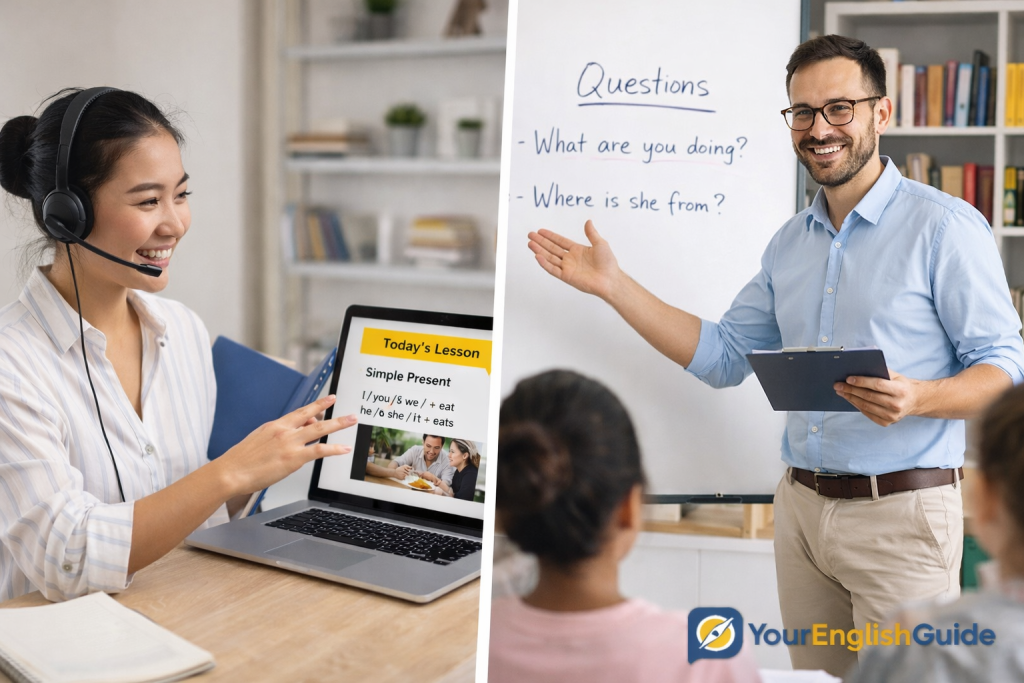
One of the biggest reasons people search for the best TEFL courses is because they want to teach English online.
The good news is that most online teaching platforms have clear, predictable requirements — and TEFL courses are designed to meet them.
Do Online Platforms Accept TEFL Courses?
Yes. Most reputable online English teaching platforms accept TEFL certificates, as long as they meet basic standards.
Platforms typically look for:
- a 120-hour TEFL certificate
- proof of course completion
- basic teaching readiness
Many job listings phrase this requirement as:
“TEFL / TESOL / ESL certification or equivalent”
This means the platform is flexible about the certificate name, as long as the training is legitimate.
TEFL vs TESOL vs ESL for Online Teaching
For online teaching, the differences between TEFL, TESOL, and ESL matter far less than people expect.
In practice:
- TEFL is the most commonly listed requirement
- TESOL and ESL certificates are often accepted as equivalents
- employers focus on course length and content, not branding
If your goal is teaching English online:
👉 a standard 120-hour online TEFL is usually the safest and simplest option.
When a TEFL Course Gives You an Advantage Online
A TEFL course can give you a real advantage if you:
- have no teaching experience
- are applying to multiple platforms
- want to teach beginners or adults
- want confidence during interviews and demo lessons
Certification doesn’t guarantee a job — but it reduces barriers and increases access.
Key Takeaway
For teaching English online, a TEFL course is:
- widely accepted
- often expected
- rarely overqualified
Choosing a recognized, appropriately sized TEFL course is usually enough to meet platform requirements.
FAQs — Best TEFL Courses
What is the best TEFL course?
The best TEFL course is one that meets employer requirements and matches your teaching goals. For most people in 2026, this means a 120-hour online TEFL course that is widely accepted by online teaching platforms and private language schools.
Are online TEFL courses legitimate?
Yes. Online TEFL courses are widely accepted in 2026, especially for teaching English online. Employers care more about course length and content than whether the course was completed online or in person.
How long does a TEFL course take to complete?
Most TEFL courses take 4 to 12 weeks to complete, depending on whether they are self-paced. Some learners finish faster, while others take more time to study comfortably.
Do TEFL courses guarantee a teaching job?
No. TEFL courses do not guarantee jobs. They provide qualification and preparation, but hiring decisions depend on interviews, demo lessons, availability, and platform requirements.
Any course promising guaranteed placement should be approached with caution.
What is the cheapest TEFL course that still works?
The cheapest TEFL course that still works is one that:
- is at least 120 hours
- has clear course content
- provides a verifiable certificate
Extremely cheap courses with unclear structure or no curriculum may not be accepted by employers.
Is a TEFL course worth it for beginners?
Yes. For beginners with no teaching experience, a TEFL course is often worth it because it replaces experience, improves confidence, and helps meet employer requirements.
Final Verdict — Which TEFL Course Should You Choose?
Choosing the best TEFL course doesn’t come down to finding the most expensive program or the one with the loudest marketing.
It comes down to choosing the course that matches your goals.
Best TEFL Course for Most People
For most beginners in 2026, the best option is:
- a 120-hour online TEFL course
- widely accepted by online teaching platforms
- clearly structured and beginner-friendly
- reasonably priced, without unnecessary upsells
This type of course meets employer expectations, prepares you to teach, and keeps costs under control.
Best TEFL Course for Teaching English Online
If your main goal is teaching English online, you usually don’t need:
- in-person training
- classroom practicum
- expensive academic programs
A standard online TEFL that meets platform requirements is enough to get started and apply confidently.
Best TEFL Course on a Budget
If budget is a concern, focus on requirements, not branding.
A lower-cost TEFL course can still work well if it:
- meets the 120-hour standard
- has a clear curriculum
- provides a verifiable certificate
Avoid paying extra for features that don’t improve employability.
Final Advice Before You Enroll
Before choosing a TEFL course, ask yourself:
- Where do I want to teach — online or abroad?
- What do employers in that space actually require?
- Do I need extra support, or just certification?
The best TEFL course is the one that:
- qualifies you
- prepares you
- fits your budget
- helps you start teaching with confidence
CTA — Choose the Right TEFL Course for Your Goals
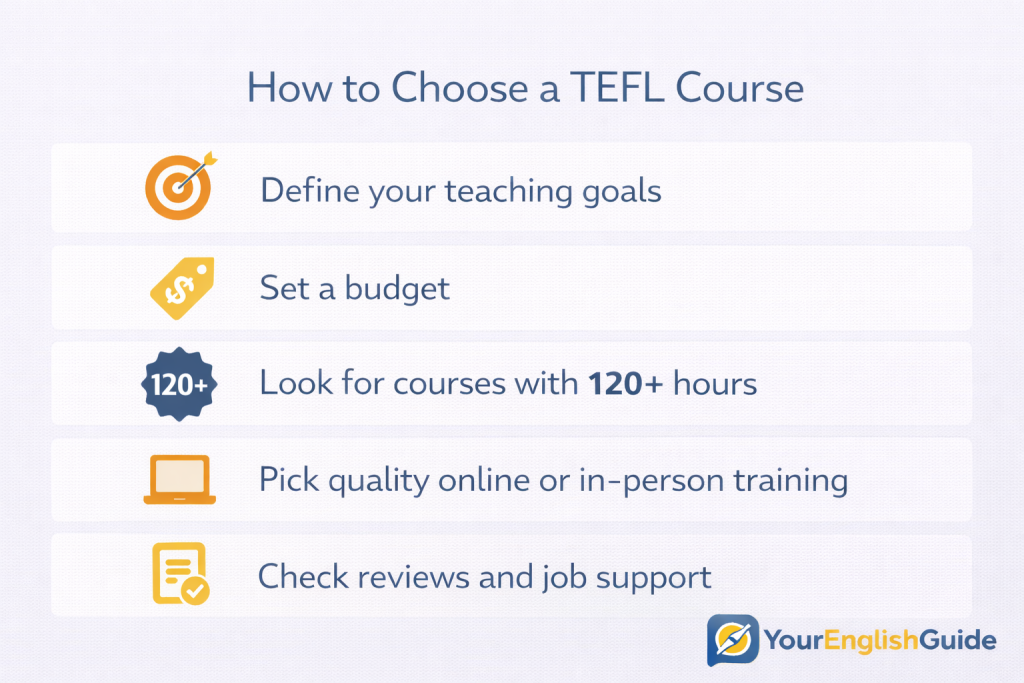
If you’re serious about teaching English, the next step is simple:
👉 Decide how you want to teach.
👉 Choose a recognized TEFL course that fits that goal.
👉 Focus on becoming a confident, effective teacher — not chasing course labels.
That approach will take you much further than any marketing promise.